Opposition to Jim Crow treatments (segregation) and voting restrictions was not necessarily only in the North, and not confined to black people either. Many white southerners hated segregation and restricting the rights of African Americans but did not speak out, yet tried in private to treat all people with dignity. It is not easy to fight injustice, especially when it goes against what your friends and family may believe.
Think about this, and write a thorough reflection which incorporates responses to the following: Do you think it would have been difficult as a southerner to help African Americans during this time? Why? Are there circumstances in your life which keep you from protesting injustice? What do you think can to be done in order to make it easier for people to fight injustices such as what happened to African Americans following the Civil War?
Thursday, October 27, 2011

Thursday, October 20, 2011
The 14th Amendment
The 14th Amendment was passed shortly following the Civil War--it stated the following:
Section 1. All persons born or naturalized in the United States and subject to the jurisdiction thereof, are citizens of the United States and of the State wherein they reside. No State shall make or enforce any law which shall abridge the privileges or immunities of citizens of the United States; nor shall any State deprive any person of life, liberty, or property, without due process of law; nor deny to any person within its jurisdiction the equal protection of the laws.
Provide a short reflection about this amendment in which you include the following--
- Your understanding about the significance of the amendment at this time (right after the Civil War).
- What is important about the language of this amendment?
- What democratic values are reflected?
Thursday, October 13, 2011
Going off to War

Imagine that you are a young man who has just volunteered to fight as a Union soldier in the Civil War (sorry girls--they did not allow women to fight as soldiers in this war). Write a letter to your parents explaining why you are going, and what YOU BELIEVE you are fighting for.
Thursday, October 6, 2011
The Second Revolution?

Thursday, September 29, 2011
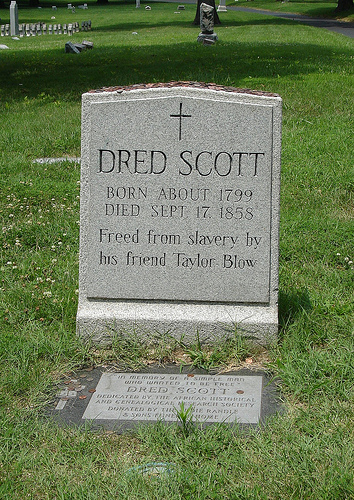
Dred Scott
In 1846 in Missouri, a slave named Dred Scott sued his owner for freedom and started a process in both state and federal that lasted for over 10 years, and ultimately ended in the Supreme Court. Scott claimed that he had been living on free soil in Illinois and the Minnesota territory, and therefore he was free. The Supreme Court decided that Scott was not a citizen and therefore had no right to bring this case to federal court; and that if he was freed it would deprive his owner of property.
 Question: If the Supreme Court had granted Dred Scott his freedom, what would that have meant for slaves in the South?
Thursday, May 19, 2011
Established Religion
Please provide one positive and one negative outcome if the United States ever established a national religion. Could it work?
Friday, May 13, 2011
Reflection on Washington
In terms of the educational value, is there any particular aspect of the Washington trip that you would change?
Wednesday, April 27, 2011

Thursday, April 14, 2011
Prior Restraint

Please share one important point that you have learned thus far as you have researched your case. Be specific, and explain it well.
Thursday, April 7, 2011
Is the First Amendment more important.........
When, if ever, is it justified for the government to suspend an individual’s civil liberties and safety for national security purposes? Shouldn't free speech rights allow individuals to speak out against the government?
Thursday, March 10, 2011
What Did You Say?
Under the Sedition Act, a man named James Callender was fined and imprisoned for making the following statement about President John Adams:
"He has never opened his lips, or lifted his pen, without threatening and scolding. The grand object of his administration has been to exasperate the rage of the contending parties, to calumniate and destroy every man who differs from his opinions."
Would you approve or disapprove of a modern politician who tried to bring back the Sedition Act today? What would you say the politician?
Would you approve or disapprove of a modern politician who tried to bring back the Sedition Act today? What would you say the politician?
Thursday, March 3, 2011
Father of the Constitution--James Madison
Please give me your thoughts on the following quote from James Madison--"A bill of rights is what the people are entitled to against every government on earth....and what no just government should refuse."
Wednesday, February 23, 2011
BILL OF RIGHTS

Go online or to your textbook--Read the first five amendments of the Bill of Rights. Which amendment do you think is the most important for U.S. citizens? Why? Place the first five amendments in order of greatest importance to least importance, as you see it.
Thursday, February 3, 2011
Beyond Brown v. Board of Education

Think about the other students at your school, your circle of friends, and the people who live in your neighborhood. To what extent do you think Brown v. Board of Education's dream of an integrated America has been made real?
Thursday, January 27, 2011
Non-Violence
Much of what the NAACP, and eventually Dr. Martin Luther King, stood for was protest without the use of violence. Would you agree that this is the most effective way to win support for a cause? Can you think of a situation where protest must be violent?
Wednesday, January 19, 2011
A New Understanding
You have finished the rough draft of your research papers--Congratulations! Please share something you learned that you did not know before you began the research process, and connect that information to what we have been studying in class. Why is this particular piece of information interesting or important to you?
Thursday, January 13, 2011
Separate But Equal

Plessy v. Ferguson (1896), the case that legalized segregation in our country, is widely considered to be the worst decision in the history of the Supreme Court. Explain why you agree or disagree with that statement.
Wednesday, January 5, 2011
This is Unfair

I would like you to make a case, briefly, that African Americans were treated very unfairly following the Civil War. How would you defend this argument, using only one supporting point.....
Thursday, December 9, 2010
The Right To Vote

In 1872, Susan B. Anthony broke the law by voting; at the time it was illegal for women to vote. For this crime she was tried, found guilty, and fined $100.00. Why do you think Anthony was willing to go through such an ordeal just to vote? Is the right to vote that important in our country?
Wednesday, December 1, 2010
Welcome to Harlem
 The trip to Harlem was informative and exciting--the rich history of Rucker's Park; the walking tour which explored the sights, sounds and culture of Harlem; the authentic and delicious soul food served at Sylvia's eatery; and finally the incredible ambiance of the Apollo Theater, and Mr. Apollo himself, Billy Mitchell. the talent show was unforgetable--can not believe the talents of our King students.
Subscribe to:
Posts (Atom)