Thursday, January 26, 2012
American Neutrality
You are an American--do you believe there was good reason for the U.S. to consider entering the war in 1914, and not follow President Wilson's policy of neutrality? What possible reasons could there be for entering the war at this time? Be specific, and really think about this. I want a complete, supported response!! Not a one sentence answer......

Thursday, January 12, 2012
Research Project
What is the most difficult challenge you have faced during the process of working on your research paper? Be specific, and explain why it was a challenge........
Friday, January 6, 2012
WAR!!!!! Can It Be Justified?
Make a case that war can NEVER be justifiable! We should never go to war........Why?
Wednesday, December 14, 2011
Thesis Statement For Research Paper
Please write your APPROVED thesis statement on the blog--Thanks!!
Thursday, December 8, 2011
History Research Project
You have all been introduced to your major assignment for this trimester, a history research project which will analyze the effects of a specified Presidential decision during wartime. Please share with the class an important fact you have learned now that you have begun the research phase of the project. Be specific, and make sure it was a piece of information you did not already know.
Wednesday, November 30, 2011
The Harlem Experience

Thursday, November 17, 2011
Was Segregation Good?
How would you respond to the following: that segregation was actually good for African Americans because it created more opportunities for blacks than integration. For instance, separate black institutions employed more principals and teachers, in schools set aside for blacks, than did racially mixed schools?
Would this be a good argument in favor of segregation? Why or why not?
Would this be a good argument in favor of segregation? Why or why not?
Thursday, November 10, 2011
Video Project
What one fact have you learned about the study of history, during the process of doing your project, that you never knew before. Expand on your response.......
Thursday, November 3, 2011
Separate But Equal
One of the major issues following Plessy v. Ferguson was the idea that "separate but equal" facilities was socially acceptable. The problem was that there was really no way possible to ensure that facilities could be equal, and in fact the white facilities were always better. Do you think if the accommodations were "truly equal" that laws like these could be
valid or acceptable? Think about schools, hospitals, restaurants, movie theaters--even water fountains!!!!
Thursday, October 27, 2011
The Strength To Speak Out
Opposition to Jim Crow treatments (segregation) and voting restrictions was not necessarily only in the North, and not confined to black people either. Many white southerners hated segregation and restricting the rights of African Americans but did not speak out, yet tried in private to treat all people with dignity. It is not easy to fight injustice, especially when it goes against what your friends and family may believe.
Think about this, and write a thorough reflection which incorporates responses to the following: Do you think it would have been difficult as a southerner to help African Americans during this time? Why? Are there circumstances in your life which keep you from protesting injustice? What do you think can to be done in order to make it easier for people to fight injustices such as what happened to African Americans following the Civil War?
Think about this, and write a thorough reflection which incorporates responses to the following: Do you think it would have been difficult as a southerner to help African Americans during this time? Why? Are there circumstances in your life which keep you from protesting injustice? What do you think can to be done in order to make it easier for people to fight injustices such as what happened to African Americans following the Civil War?
Thursday, October 20, 2011
The 14th Amendment
The 14th Amendment was passed shortly following the Civil War--it stated the following:
Section 1. All persons born or naturalized in the United States and subject to the jurisdiction thereof, are citizens of the United States and of the State wherein they reside. No State shall make or enforce any law which shall abridge the privileges or immunities of citizens of the United States; nor shall any State deprive any person of life, liberty, or property, without due process of law; nor deny to any person within its jurisdiction the equal protection of the laws.
Provide a short reflection about this amendment in which you include the following--
- Your understanding about the significance of the amendment at this time (right after the Civil War).
- What is important about the language of this amendment?
- What democratic values are reflected?
Thursday, October 13, 2011
Going off to War

Imagine that you are a young man who has just volunteered to fight as a Union soldier in the Civil War (sorry girls--they did not allow women to fight as soldiers in this war). Write a letter to your parents explaining why you are going, and what YOU BELIEVE you are fighting for.
Thursday, October 6, 2011
The Second Revolution?

Thursday, September 29, 2011
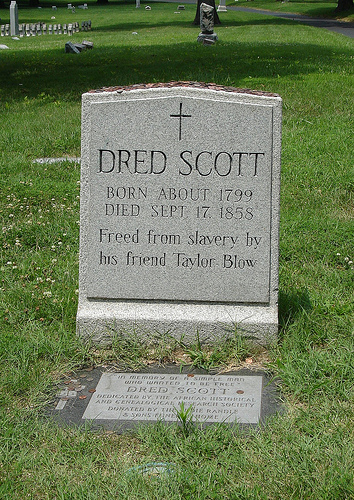
Dred Scott
In 1846 in Missouri, a slave named Dred Scott sued his owner for freedom and started a process in both state and federal that lasted for over 10 years, and ultimately ended in the Supreme Court. Scott claimed that he had been living on free soil in Illinois and the Minnesota territory, and therefore he was free. The Supreme Court decided that Scott was not a citizen and therefore had no right to bring this case to federal court; and that if he was freed it would deprive his owner of property.
 Question: If the Supreme Court had granted Dred Scott his freedom, what would that have meant for slaves in the South?
Thursday, May 19, 2011
Established Religion
Please provide one positive and one negative outcome if the United States ever established a national religion. Could it work?
Friday, May 13, 2011
Reflection on Washington
In terms of the educational value, is there any particular aspect of the Washington trip that you would change?
Wednesday, April 27, 2011

Thursday, April 14, 2011
Prior Restraint

Please share one important point that you have learned thus far as you have researched your case. Be specific, and explain it well.
Thursday, April 7, 2011
Is the First Amendment more important.........
When, if ever, is it justified for the government to suspend an individual’s civil liberties and safety for national security purposes? Shouldn't free speech rights allow individuals to speak out against the government?
Thursday, March 10, 2011
What Did You Say?
Under the Sedition Act, a man named James Callender was fined and imprisoned for making the following statement about President John Adams:
"He has never opened his lips, or lifted his pen, without threatening and scolding. The grand object of his administration has been to exasperate the rage of the contending parties, to calumniate and destroy every man who differs from his opinions."
Would you approve or disapprove of a modern politician who tried to bring back the Sedition Act today? What would you say the politician?
Would you approve or disapprove of a modern politician who tried to bring back the Sedition Act today? What would you say the politician?
Subscribe to:
Posts (Atom)